Planting 1,000,000 trees – collaboration
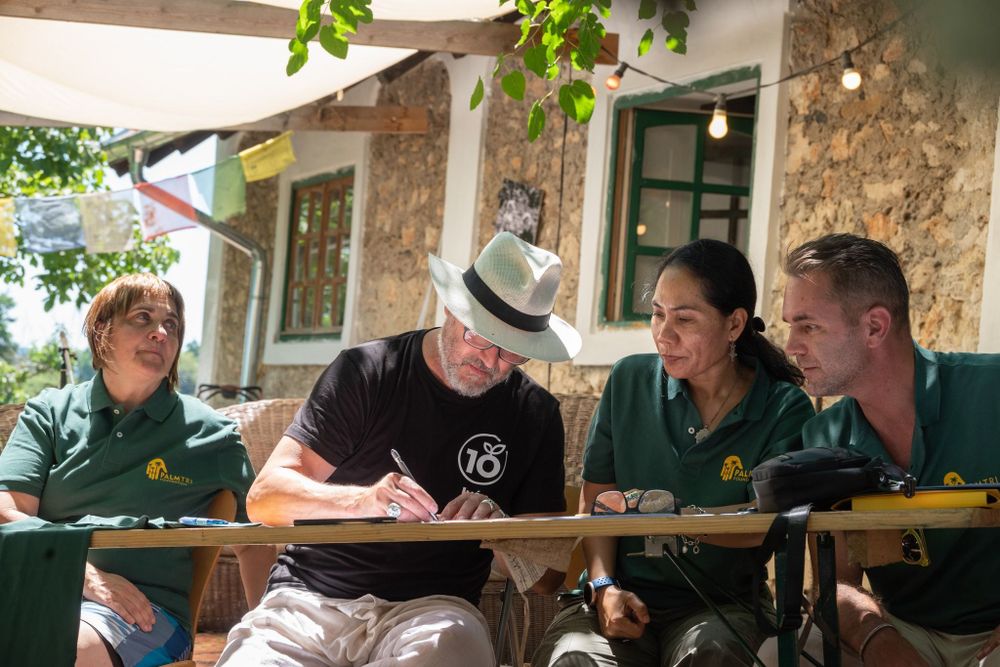
We have been collaborating with Márk since the launch of 10 Million Trees. He lives on Lombok Island in Indonesia. It is a source of pride that he is also the representative of 10 Million Trees – Indonesia, while achieving incredible results in the remote country with his own Palmtri Foundation. In two previous planting events, we worked together to plant tens of thousands of trees. Now we are weaving new plans, as the climate disaster is a global issue that we must (and can!) work on globally.
Gauder Márk: We are at two and a half million trees | Interview with Andrea Nichs
– We recently met on the Saint George Hill during the fifth anniversary of 10 Million Trees, where you mentioned that due to a misunderstanding, significant legislation is being created in Indonesia for the protection of trees. Can you elaborate on this?
I was just at home in Hungary, walking in Budapest on Mészáros Street, where a horse chestnut tree stands behind a statue of Miklós Melocco, with a sign indicating that this tree is protected. I took a photo and sent it to my brother-in-law, Dr. Yulias Erwin, who is a Doctor of Law at Muhammadiyah University in Indonesia, and he immediately took action.
He felt that something needed to be done, as it seems that the whole world has realized that even a single tree is so valuable that it is protected at every street corner, while Asia is lagging far behind, where instead of protection, they are bulldozing the rainforests.
He contacted the rector of Ahmad Dahlan University in Yogyakarta, and they started to develop a draft law. This has since been completed, and I believe that as soon as the new president is inaugurated in the fall, it will be submitted. The essence of the proposal is that trees, as legal entities, should receive protection, meaning that illegal loggers can be held accountable for cutting down even a single tree, and such actions should have serious criminal consequences.
– How and why did you establish the Palmtri Foundation, and what is its connection to 10 Million Trees?
I was not always specifically an environmentalist, but when I moved to Lombok, I saw that entire forests were being cleared without any consequences.
Deforestation causes devastating floods and disrupts the entire ecosystem. This destruction unfolded before my eyes.
While in Europe, people are currently only experiencing that summers are getting hotter, drier, and more drought-prone due to climate change, in Indonesia, environmental destruction is a daily, pressing issue with immediate visible consequences, as such an environmental disaster can render 100,000 people homeless in an instant.
When trees are cut down, they do not consider that the forest is a watershed for a river, and when the rainy season comes, a ten-meter wall of water can rush down, washing away an entire neighborhood. For example, during the last heavy rainfall in Jakarta, more than a million people lost their homes.
To answer your question: after I moved to Lombok, I started dealing with real estate investments, and we utilized part of the land for tree planting.
The first five years were practically spent on land purchases and tree planting with my wife, and we became well-known on the island.
There are significant infrastructure investments happening there as well, new roads are being built, but the planning does not extend to at least reforesting the adjacent areas as a form of damage control.
Seeing this, we teamed up with a nature conservation association in Lombok and committed to planting one million trees within a year. In response to this news, a representative from the Ministry of Environment visited us, and he was so taken with the idea that he contributed an additional 800,000 saplings, thus transforming the initiative in North Lombok into a massive program.
At that point, we established our own organization, named Palmtri. The name is an Indonesian acronym composed of the words pagar, alam, and lestari, meaning: fence, nature, sustainability.
The fence refers to a protective, green hedge that conveys a positive message of security. Alongside my wife, my father-in-law and brother-in-law also joined in, as it was more challenging for them to handle the administrative processes as foreign citizens due to various legal procedures. Our foundation and the 10 Million Trees initiative were born around the same time, and we began working together, as it doesn’t matter where you plant; we are talking about one atmosphere. This is how I also became a traveling ambassador for 10 Million Trees in Indonesia.
– When I think about the fact that we are now at nearly 400,000 trees planted, while your first-year commitment was 1 million 800 trees, the question arises: how can such a huge number be achieved?
In Indonesia, due to the climatic conditions, planting is significantly easier. In Hungary, there are only a couple of weeks in spring and autumn suitable for planting.
On the other hand, it also matters technically how large a hole needs to be dug, what size root ball to use, and how well-prepared the sapling should be. There are tree species here whose 30 cm long, fallen shoots can be sharpened, placed in a germination bag, and are practically ready for planting after three weeks. Or you can simply place them in wet habitats, and planting can still be successful even in the middle of the dry season.
These simpler species, for example, are suitable for replanting cornfields. They grow quickly, provide shade soon, their root systems hold the soil, and in the following years, more useful, endemic trees can be planted among them.
This creates a biodiverse landscape instead of a monoculture cornfield. Thirdly, there is the legal factor: 80% of Indonesia’s territory is state-owned, not private land, making the regulations in Europe extremely complicated by comparison. There, to create a roadside forest strip, it is sufficient to talk to the road authority or the local regent, and the afforestation can proceed for twenty kilometers without the bureaucratic hurdles present here.
– Where do you stand now in terms of the number of tree plantings after five years?
It is already impossible to keep track, but it is around two and a half million. More and more smaller communities that have split off from us are planting, and this mental revolution has turned into a flowing tide.
Many have realized that protecting nature is important; a tree is not just something I can cut down and take home to cook with. We have volunteers in East Lombok and West Sumba who have already become independent and are carrying forward the fire they received from us, although professional advice, education, and knowledge transfer are still needed.
I believe it is extremely important for a person to take action for their environment. I also try to influence the development in the direction of sustainability where I live.
In terms of tourism, for example, we would like to establish a nature conservation area in the gorge between Lombok and West Sumbawa. Currently, there is an operating gold mine there, which is expected to be depleted around 2035, and the governor believes that industry must be developed to preserve jobs.
But why should we, and what kind of industry should be established in such a remote, untouched natural environment?
Everything would have to be brought in and transported out, which would have an enormous ecological footprint, not to mention the unnecessary infrastructural investments. This would cost the state a fortune, and in return, there would be a thousand jobs next to some industrial production line, which would be replaced by robots tomorrow.
We are currently lobbying to protect this natural beauty, to not destroy it further, but to involve private investors, and instead, to focus on developments in eco-tourism. This would not cost the state a penny; they only need to ensure that there is a strict eco-tourism regulation with a maximum buildable limit.
– What helps such initiatives to get through to the government, to the upper management?
On one hand, if they see a business opportunity in something, if private interests are at play, that is a great help. On the other hand, this country is culturally so different; it is possible to influence it through religion and traditions, we just need to reach back to the “slogans” embedded in the culture.
Moreover, the generation that grew up in an untouched, beautiful natural landscape is still alive. When there were not dried-up riverbeds everywhere, but crystal-clear water in them for ten months of the year, which provided a home for huge shrimp.
They still remember what it was like when there was no need to drill 100-meter-deep wells, and the hills were covered with massive mahogany forests.
Now, due to corn, whose roots cannot hold the soil, the sun-baked land remains, scorched by the sun, the humus turns to dust and is carried away by the wind. The rainy season then washes away the little humus left into the stream, the stream carries it into the lagoon, which becomes silted, the corals die out, there will be no more fish, and so on. Such everyday, visceral experiences prompt the country to take quicker steps. But it is also a realization for them that after the European Union withdrew its acceptance of palm oil, there are vast areas devastated because of it.
A twenty-something Indonesian boy came up with the idea that instead of plastic straws and nylon bags, we could make these from sea grass, which is a biodegradable material. But what will happen if the same thing happens with this as with palm oil: that is, vast areas will start to be cultivated with sea grass because Europe needs to produce four trillion straws and bags daily?
Will all the coastal habitats, where 70-80% of marine life occurs, be planted with it, and will the local ecosystem be eradicated?
– You mentioned cultural embedding, that it is worth returning to existing cultural patterns for education and message transmission. Could you give an example of this?
In Indonesia, there is a saying related to religion that the world is a gift from God. If that is the case, then it must be valued; if it was given as a gift, it must be cared for and protected.
The religious approach becomes a catchphrase and has a greater impact, becoming ingrained. We need to find out where, which line of thought resonates with people. For example, we convened local eagle leaders with the previously mentioned Lombok nature conservation association, because in their culture and tradition, there is a strong religious notion that they are also part of nature.
We appealed to this, saying that if this is the case, then it is extremely important to protect the environment, as you are also part of nature. Such simple, easily understandable ideas need to be revived, and since this is part of their tradition, they feel that they must take action for it.
Everyone received a tree to take home and plant in their garden. From this tradition, a system of norms was established, and it became a custom. In this spirit, the community is now taking care of the trees. Moreover, since it is part of their tradition and not a top-down directive, it is more readily accepted and integrated into their lives.
– So, if you apply such a cultural anthropological approach, you can reach your goals more easily… What are your further plans with the foundation?
Although the foundation is registered throughout Indonesia, I believe we will not move beyond Lombok and Sumbawa, as there is still much to do there. Beyond effective planting, influencing legal regulations is an exciting task, and fortunately, we have partners in Muhammadiyah and Ahmad Dahlan University.
The fact that the 10 Million Trees initiative is also involved in this work is important because it helps maintain enthusiasm. When locals see that a European organization is participating in the work, it serves as an effective marketing tool: look, Europeans care more about whether your child will have drinking water, so you should do something too, wake up and take action.
I feel that I have contributed to the change in mindset, and I see that it is rolling forward on its own; something has changed in people’s minds. The Indonesian Bar Association, along with many other companies, is celebrating its anniversary by planting trees. Changing attitudes and mindsets is the most important achievement.
Of course, education remains very important, so that the enthusiasm does not become just an Instagram story. This is why collaboration with the university is beneficial, as they continuously organize professional conferences and educate the population.
– Have you thought about bringing this mindset to Morocco, where you currently live?
I’m sure I will do something there as well, but I see that this country takes sustainability the most seriously on a global scale. If you look at their indicators, you will see that Morocco is first in the world in sustainability developments and in adhering to the Paris Climate Agreement.
They have far exceeded what they committed to. In 75% of the country, only renewable energy is used, and their reforestation program is exemplary.
Morocco has also experienced massive landslides and floods at the foot of the Atlas Mountains, after which the king went there, and in the following months, four million trees were planted. When a natural disaster occurs, this is the priority, as was the case after a major earthquake when thousands of people were left homeless.
My brother and I also started a collection in our neighborhood to help at least those living around us, but it wasn’t necessary, as the dangerous debris was cleared within days, and the renovation began immediately.
There is much to learn from Morocco, as they have always lived in a very dry environment where a garden is the ultimate luxury, the symbol of paradise.
When the king comes to power, he does not erect a statue or an arch of triumph, nor does he build a massive concrete structure; instead, he creates a new public garden for his people.
The city of Marrakech is filled with beautiful public parks, where fountains gurgle and cool, shade-giving trees stand. Next to the city center, there is a 180-hectare olive grove, which is the king’s private property.
It has not been subdivided into residential complexes or high-rise buildings because the king said that the people living in the interconnected, winding streets need this grove to sit under the trees for picnics in the afternoons, and that this olive forest provides oxygen to the UNESCO-protected old town right next to it.
The garden is the most valued thing that exists there.