“We treat forests as a cutting resource.”
He relies solely on official data, but the astonishing figures sometimes make him wonder when they will stop being published. Zoltán Kun, a forestry technician, landscape architect, and soil engineer, is primarily focused on the protection of Hungary’s natural forests.
This interview is part of our series featuring renowned scientists and ecological experts, including Vilmos Csányi, Alexandra Köves, Ferenc Jordán, Réka Aszalós, András Lányi, and others, who have shared their thoughts with us on the future we face amid the ecological crisis.
The president of the Great Lakes and Wetlands Association and a member of several working groups, he is currently a staff member dealing with forest and climate policy at the Forest Defenders Alliance and the Wild Europe Foundation.
Recently, in an article published on Greenfo, you provided shocking data: the total area of Hungary’s natural forests is half the size of the Audi Hungaria site in Győr…
For years, the area of natural forests in Hungary has remained relatively stable at around 355 hectares. This represents 0.018% of all forests, while invasive tree species occupy an area 64 times larger. And yes, where the Audi facility is located, it covers about 500 hectares, even larger when including the logistics area.
The shocking part is that this is public data; these figures are not provided by civil organizations but by the Ministry of Agriculture. Considering that the government is planning to establish a 600-hectare industrial park in the areas of Bicsérd, Kővágótöttös, and Kővágószőlős, partly on the Pécs water base, that area is nearly twice the size of the natural forests.
– You deal with many things: forests, animals, waters. How do you find time for everything?
Essentially, this should be understood and examined as a complex system, and due to the Carpathian Basin, wetlands are very important in Hungary.
There are many forests, and there should be even more that depend on wetlands. In 2019, when I read about the planned water facility development near Lake Fertő, I discovered several errors in the documentation, but no one wanted to take up the issue, so we founded an association.
Fundamentally, there are several developments at our larger lakes, such as Lake Tisza, Lake Balaton, and Lake Tata, with which I cannot agree because they are ecologically inappropriate.
In each case, these seemingly foolish developments follow a similar pattern, which is why we established the Great Lakes and Wetlands Association. To answer your question, I have rather been drawn into these issues, but I already feel a sense of responsibility towards them.
– Why is it so important for a forest to be natural? Don’t planted forests or invasive tree species produce oxygen and bind the soil in the same way? What’s wrong with having much more black locust than native pedunculate oak?
Of course, a locust grove is still better than a logistics center, but its diversity is much lower than that of a natural forest; it is a species-poor wooded area.
I consciously avoid using the word forest because it would be an important change in our thinking if statistics did not classify locust groves, planted coniferous forests, and other tree plantations as forests.
If we did not consider these as forests, but rather as plantations of woody plants, people would have a clearer understanding that the extent of forests in our country has not increased since World War II.
This needs to be clarified. Some believe that evolution will eventually correct the current situation, but in the short term, the spread of non-native tree species and other plants is definitely harmful.
It takes a long time for evolution to compensate for the disadvantages and for the local insect world, soil biology, microbiology, and other herbaceous species to adapt to the acacia forests. I am fundamentally not talking about the survival of species, but rather the survival of Homo sapiens.
Species have gone extinct before, and new ones will come that will adapt, or others will take their place. What I am working for is our own survival. Of course, we could also go extinct like the dinosaurs; the question is whether we want to become extinct.
I believe that there should be a place here for my grandchildren and great-grandchildren, but for that, we need to rein in our lifestyle. If we do not hold back, we will meet the same fate as the dinosaurs.
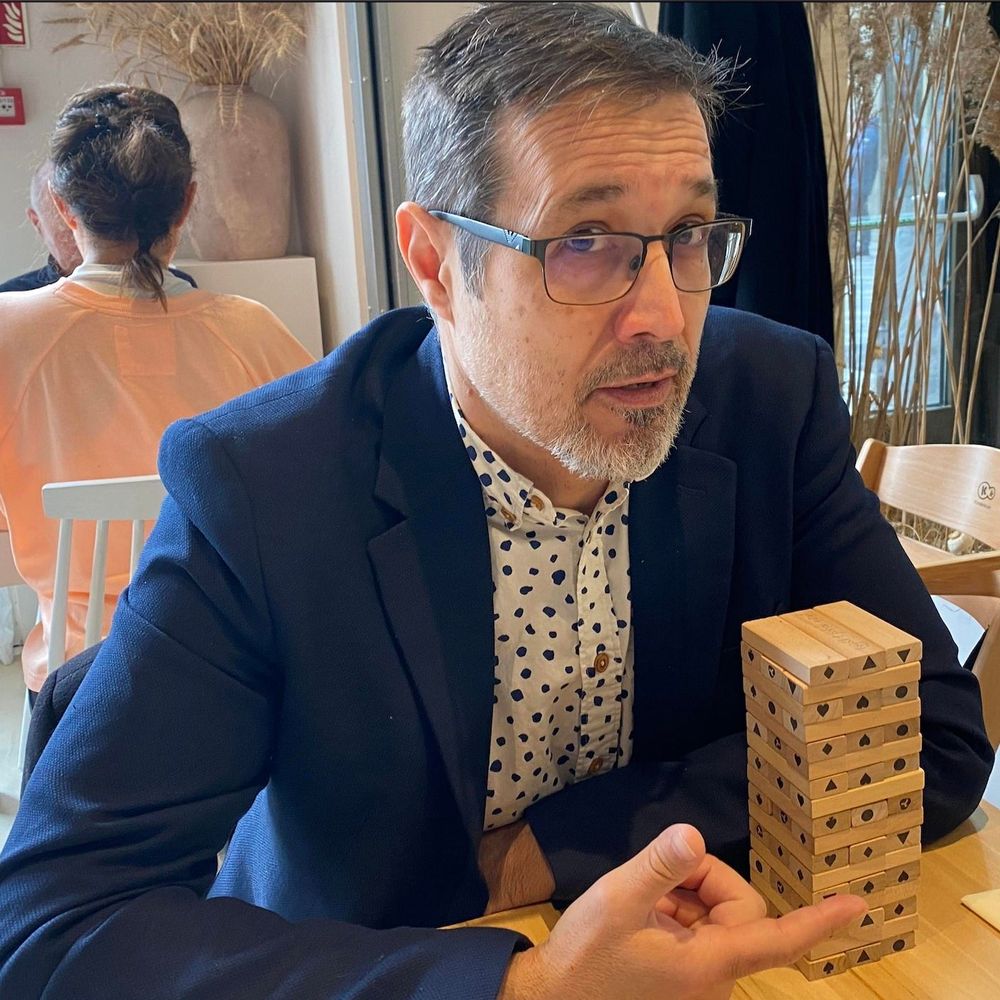
– Since this is an article, I must mention that you are just taking out a Jenga game made of wooden blocks, which many people are surely familiar with. What does the tower symbolize?
One of my pet topics lately has been sustainability. I have a colleague who has banned the use of the word sustainability in our team, and I must say, he is fundamentally right.
In this case, the Jenga symbolizes sustainability; it represents a healthy biosphere, the ecosystem in which we live. Until recently, humans were part of this ecosystem as long as they lived within tribal frameworks and took only what they truly needed from the forest.
Let’s take out one block from the Jenga, let’s say it represents water management, and place it on top. The growth of the tower symbolizes development. So, we thought it was good to channel waters between dams, cutting off the backwaters and side branches from the main riverbed by building dams.
Then let’s take out another Jenga block, representing the forests from which we build houses, make tables, paper, packaging materials, and so on.
Next, we remove the bear from this system, let’s symbolize it with a Jenga block and place it on top of the tower.
We are developing, the tower is growing, but then we take out another block; let’s say an investor thinks it’s a good idea to build hotels and a marina along the shore in Aliga. After a while, however, we will have built around Lake Balaton so much that what we originally went there for will disappear.
Now the tower starts to wobble; it is still standing, but if I pull out one block, the whole thing will collapse, sustainability will collapse. This is what needs to be rebuilt, but investors, political systems, and bankers do not really understand this.
– Returning to forestry, why is it not conducted sustainably in Hungary?
In the case of forests, they support the myth of sustainability by claiming that the area of forests is increasing, but this is a lie. As I mentioned earlier, these are not forests; these are plantations of woody plants.
We are currently at a point where 18% of forests are monocultures, and only 18% contain more than three tree species, meaning that 82% of forests in Europe consist of one or two, at most three tree species. This is very alarming.
If we look at the report compiled by the European Environment Agency, based on the member state reports published every six years, it is clear that 14% of the forests within Natura 2000 areas are in a suitable natural condition. And I am not talking about forests in general, but only about protected forests.
– How much do foresters like you?
These are not partisan data; these reports come from the public sector, which foresters are, in my opinion, fully aware of, and thus they are also aware of the significance of the problem. Several of my former classmates left the public sector precisely because they were fed up with what was happening there.
I am a member of the National Forestry Association, I read professional journals, and I merely amplify the data that can be found in them. Sometimes I wonder when they will stop publishing this data.
In my opinion, the Hungarian state pursues a two-faced policy: what is communicated at home is different from what is communicated abroad.
For example, let’s take what the Hungarian state has committed to together with other EU member states in the European biodiversity strategy. They committed to increasing the extension of protected areas by 30% at the EU level, and that 10% will be the extent of strictly protected areas at the EU level.
Today, 53% of the forests in Hungary are state-owned; why shouldn’t this be achievable?
It is merely a matter of decision whether we have strictly protected forests.
– What does protection mean?
It refers to geographically defined areas that we continuously monitor and protect effectively. In Hungary, 0% is what the government can prove to be a protected area according to any independent organization’s classification. But, like many other things, this can also be started at the local level.
When the state wanted to reclassify a 400-hectare agricultural area, which is otherwise worthless from a conservation perspective, into a significantly disruptive industrial area, the people of Győrszentiván woke up and said, explain why more industry is needed here, treat us as adults.
The result was that whoever ran for election in the name of the civilians collected 70% of the local votes. This also proves that action can be taken at the municipal level because there we can connect people to local values and experiences that they can resonate with. And this will still have national, even international effects.
We could confront our local leaders with what István Nagy and Viktor Orbán committed to. They did not commit to becoming a battery superpower, but to having 30% protected and 10% strictly protected areas in Hungary. But where and when?
– Speaking of local initiatives and civil movements, here is the program announced by 10 Million Trees starting next year: National Tree Planting Day. Even if it doesn’t solve the problem immediately, it is very important in terms of shaping attitudes. What do you think about these civil initiatives?
As far as I know, I try to help. Local civil communities need to be supported, but it is also important to highlight that all of this needs to be coordinated with general habitat restoration; I am talking about rewilding now.
Let’s plant those 10 million trees where they belong.
Let’s not forget that Hungary ranks second in the European Union with an 84% loss of wetlands, which is a significant number.
In our country, more wetlands have disappeared only in Ireland over the past 300 years. For example, part of the planting of 10 million trees could be carried out in parallel with the restoration of wetland and forest habitats. The two initiatives could greatly reinforce each other.
Years ago, at a conference, a Slovak Member of the European Parliament stated that at this moment, we treat forests like livestock.
The cutting maturity age – which we determine, of course – is a hundred years for oak. When it reaches that age, we cut it down.
This is like shooting anyone in human society who reaches the age of 18. The oldest oaks live 700-800 years, but the oldest European tree is 9,500 years old in a Swedish national park. People think they have the right to decide about everything, regardless of the species.
We will decide whether it has the right to live and how long it has the right to live. This is a slaughterhouse, nothing more.
– How much profit do Hungarian state forestry companies generate?
In 2023, they generated 9 billion in profit, with a net income of 6 billion forints, which is about 15 million euros. This is less than what the Hungarian state spent on the destruction of the Fertő Lake water site.
For 6 billion forints, we are castrating Hungarian forests, which makes no sense. We need to change our mindset! At the moment, state forestry companies, if I remember correctly, employ about six thousand people.
If we were to protect these areas more rigorously, there would still be jobs for conservation officers, researchers, tourism, and accommodation providers, so it wouldn’t even lead to job losses.
Of course, there would obviously be a few top forestry executives who would suffer from this, but if we try to serve the interests of this narrow economic circle, we will be the ones to suffer.
Previous interview: Vilmos Csányi – creative imagination
Source of the interview: Vulkán magazine | https://vulkanfolyoirat.hu/nichs-andrea-kun-zoltan-az-erdoket-vagoallatkent-kezeljuk/