A fifty-year-old tree will be fifty years old in less than fifty years.
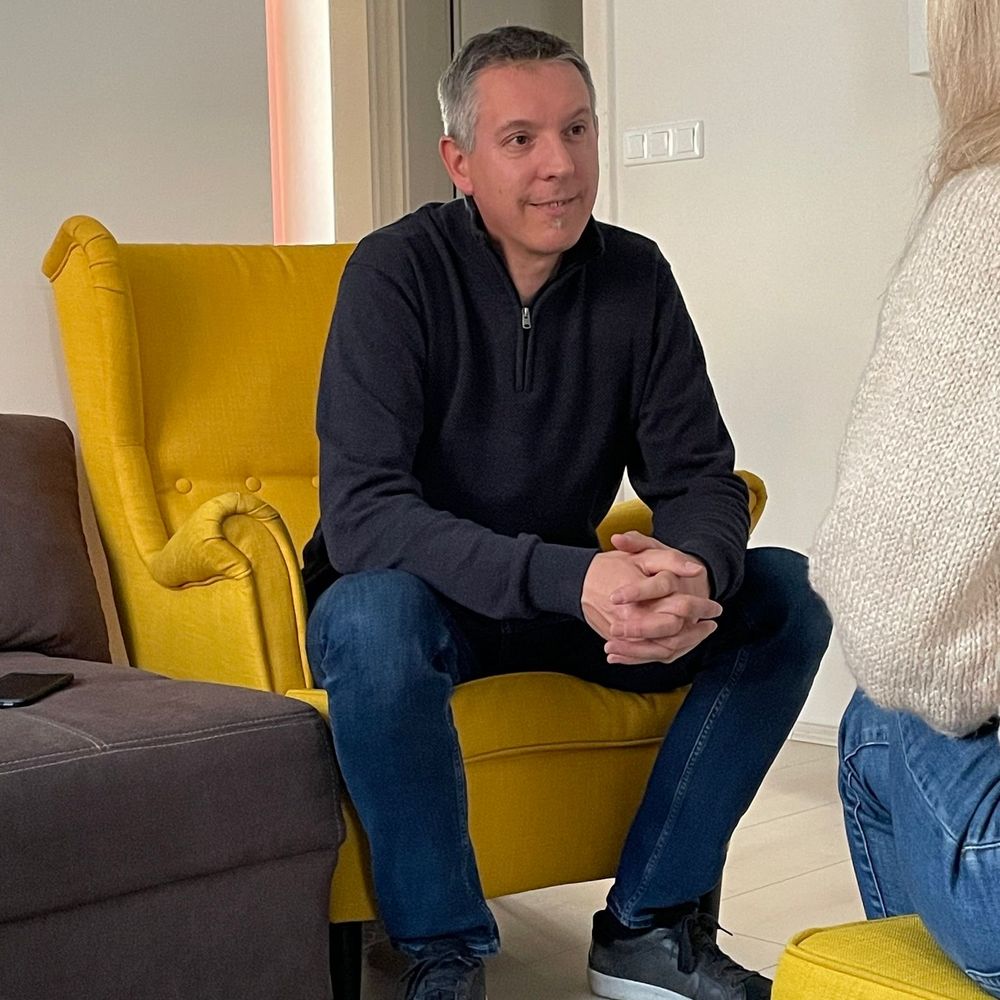
After a moment of hesitation, he says his favorite is the pedunculate oak, but he is also impressed by the beech forests, whose trees rise and connect like a cathedral of energy. The forestry expert of 10 Million Trees is also a great friend of birds, and as a person who lives in nature, he enjoys mushroom picking and hiking.
– Where does your love for nature come from? Being a “country kid” clearly shaped your perspective?
Yes, the motivation clearly comes from my childhood. My father was a forester, and we often explored the 2000 hectares of forest that belonged to him, which left me with countless memories.
Back then, there was no internet, no mobile phones, and there was no broadcast on television on Mondays; we lived in a completely different way. We didn’t need to be kicked out of the room to go outside; rather, we had to be dragged back in. My friends and I would hop on our bikes every day, head to the “mountain,” eat whatever we found there, and play with what was around us.
I grew up in Zala, attended elementary school there, and my father worked at the local agricultural cooperative, surrounded by beautiful beech and oak forests. Meanwhile, I was born in Vas County, and I still live here; I completed high school in Sopron, where I attended a forestry vocational school. As a boarding student, I explored the forests of the Sopron Mountains and Szárhalom during practical training and weekends.
I also started birdwatching early on, which was a great learning process and experience in active nature conservation. As a teenager, I spent all my school breaks in birdwatching camps, mainly but not exclusively throughout Zala County, where we monitored various species and restored their habitats. These were the kinds of activities I enjoyed during my childhood. I literally lived in harmony with nature. Reading the books of Gerald Durrell and István Fekete was fundamental.
– So you know the forest like the back of your hand? At least the one around Gelse…
I know it, and perhaps I feel it a bit too. I hiked a lot, which helps navigate it. In Hungary, you can’t really get lost in a forest; you might just walk a bit further before reaching a populated area.
– As a serious professional, you joined the 10 Million Trees civil initiative, which was started by an art historian. What do you see in terms of professional development within the team over the past years?
As a background, I would like to mention that I actually left the forestry profession. When we studied logging in high school under the guise of forest management, they associated professional arguments with clear-cutting, such as it being economical, easily mechanized, and not requiring expertise, etc. At that moment, I decided that I would not do this because that was not why I came here.
I chose to focus on regional development instead, working on projects related to energy efficiency and sustainable development since ’97. I participated in numerous habitat reconstruction programs, developed and led environmental projects, and served as a climate protection officer, but I missed the forest.
When I read Iván’s post in 2019, it was an extremely hot summer, and I was thrilled that finally, not just professionals understood how serious the problem was. Moreover, Iván writes excellently and can communicate with people very well—foresters don’t write such texts—so I felt I needed to get involved.
At first, I only wrote a list of about ten items on how to get started, what mistakes to avoid, but I also had a desire to act and a motivation so that this process wouldn’t die due to professional thoughtlessness.
After that, I was called, we met, and since then I have been a committed member of the 10 Million Trees initiative. I started from a place of limited knowledge as well; I laugh at myself now, remembering that as a primary school student, I initially peeled sunflower seeds for bird feeding… This community also started with good intentions but little concrete knowledge.
Today, we have a central team equipped with professional knowledge that can coordinate hundreds or even thousands of volunteers correctly on a professional level each year. The core team does not find either reforestation or tree planting in densely built urban environments to be insurmountable challenges, and importantly, they are capable of implementing all of this professionally.
– What is your specific role at the foundation, and how much time can you dedicate to this volunteer activity?
I became the forestry expert for the team, assisting with the professional aspects related to tree planting, but I am also involved in the processes as a project developer and operational advisor.
Initially, it was important to explain the basic forestry concepts, for example, that a fifty-year-old tree takes fifty years to reach its fifty-year-old size and appearance. To reach that age, it is essential to know what is needed for its planting and care, to understand how much space each tree species requires, and so on. We started from scratch, explaining the basics of the profession to teachers, economists, and civilians alongside my expert colleagues, including gardeners and forest ecologists.
Today, the inner circle has a wealth of knowledge; we mainly need to fine-tune the processes, especially during the planning phase. There is a core group of 20-30 people who already have a serious professional background. It was a very important realization from Iván and his team from the very beginning that we must be professionally grounded; otherwise, it won’t work.
And how much time do I dedicate to it?
I always run my life at 120%; when I commit to something, I do it wholeheartedly. Initially, I thought I would dedicate 2-3 hours a week, but now, if I were to call it a full-time job, my family wouldn’t be surprised. Just recently, we returned from a tree planting event in Transylvania.
– Hopefully, there are fewer climate change deniers, but most people oscillate between the opinions of “the scientists will solve it” or “it’s just a drop in the ocean what an individual can do.” What do you think about the issue of personal responsibility?
You decide how much you drive, how much you shop, how much energy you use, and how you shape your life. Personal responsibility cannot be denied. But it is also important to see that those who truly hold decision-making power are the ones who concentrate resources in their hands, who shape the regulatory environment that directly affects our lives. Although ultimately, we also choose this economic and political power…
Of course, much depends on the communication that influences the decisions of individuals and economic actors, as well as the media that influences it, whose role is more significant and whose responsibility is much greater than people might think. But I believe that overall, this is a shared responsibility, even if the degree of it varies among different actors.
– A recent survey was published that maps the forest cover of European countries. Hungary, to put it mildly, does not perform well; we are among the last. What do you think, why isn’t the government more involved in this? Can’t one successfully campaign on environmental protection?
Two-thirds of our forests were taken from the country after Trianon. This is unfortunately a fact. It is more worthwhile to view the Carpathian Basin as a whole, as today’s Hungary is located in the middle of this fertile plain, fundamentally an agricultural landscape.
Although, like everywhere else, there were larger areas of forest in the territory of present-day Hungary before human times, this does not necessarily make the comparison of forest cover with predominantly mountainous Austria or Slovakia relevant.
Nevertheless, such a map is very important because it confronts people with the facts and strengthens the demand for a higher percentage of forest cover. We currently have 2 million hectares of forest, and growth is important and possible.
The official government goal is to increase the area of forests to around 27% with an additional 700,000 hectares. The EU average, by the way, is 39%. At the same time, it is equally important that our existing forests are of good quality, with high biodiversity, native and climate-resistant species, and great diversity in age and species composition. This would be the rational goal, as well as increasing wooded areas, windbreaks, and tree rows in agricultural areas and around our habitats. The 10 Million Trees initiative plays a significant role in this.
If all goes well, a related EU regulation will soon come into effect, requiring that 4% of every large agricultural area be kept green, which can significantly include wooded areas.
– What is your vision for the future? Are you some kind of ecological missionary who acts for the rest of your life? How much do you believe that change is possible?
Like everyone else, I do this because I love it and because I believe in it. I must think about the future as well, as I have four daughters and a significant responsibility towards my family. Besides, it feels very good to plant trees; I am doing something good, it recharges and energizes me. I am also motivated by the fact that we are doing something useful, and we do it with a team whose members listen to each other and act effectively along beautiful ideas.
– Do you have, say, three pieces of advice for an average person: how can we contribute to improving the situation?
There aren’t three; rather, there would be one: the most important thing is to try to view the current ecological and climate situation in a complex way. One cannot isolate a single factor that would have the greatest impact among our actions. Instead, we must always be aware that every decision we make affects our environment in some way. Everything is interconnected.
In an ecosystem, a single leaf simultaneously represents a micro-power plant for the tree, provides shade for the leaf litter, or serves as a small resting place for a caterpillar.
With every action, we exert a complex impact; we must never lose sight of this. Let’s try to exert the least possible impact.
No matter how much greener a product we buy, its production still requires fossil energy, and its transportation causes local air pollution, while we also have to deal with its waste. All of this requires space, which is why forests were cut down at some point.
For example, it is not solar or wind energy that is the cleanest energy – but rather the energy that is not consumed. We cause the least harm when we consume less, live in closer harmony with nature, and compensate as much as possible for our unavoidable negative impacts. Planting a biodiverse forest is truly a great solution for that!
The other essential thing is not to underestimate education and setting an example for our children. What we demonstrate will work; actions have great power. After all, that’s already two pieces of advice…
The third is to buy wine from local producers. Are you writing this down now? Oh well, I’ll take it on…