Creative imagination
What measures the success of wild dog hunting, how many times greater is the total mass of humans and their pets compared to that of wild animals, what constitutes a community, and why is imagination important in human evolution – these are just a few of the topics we discussed with Vilmos Csányi in relation to his recently published book, Creative Imagination.
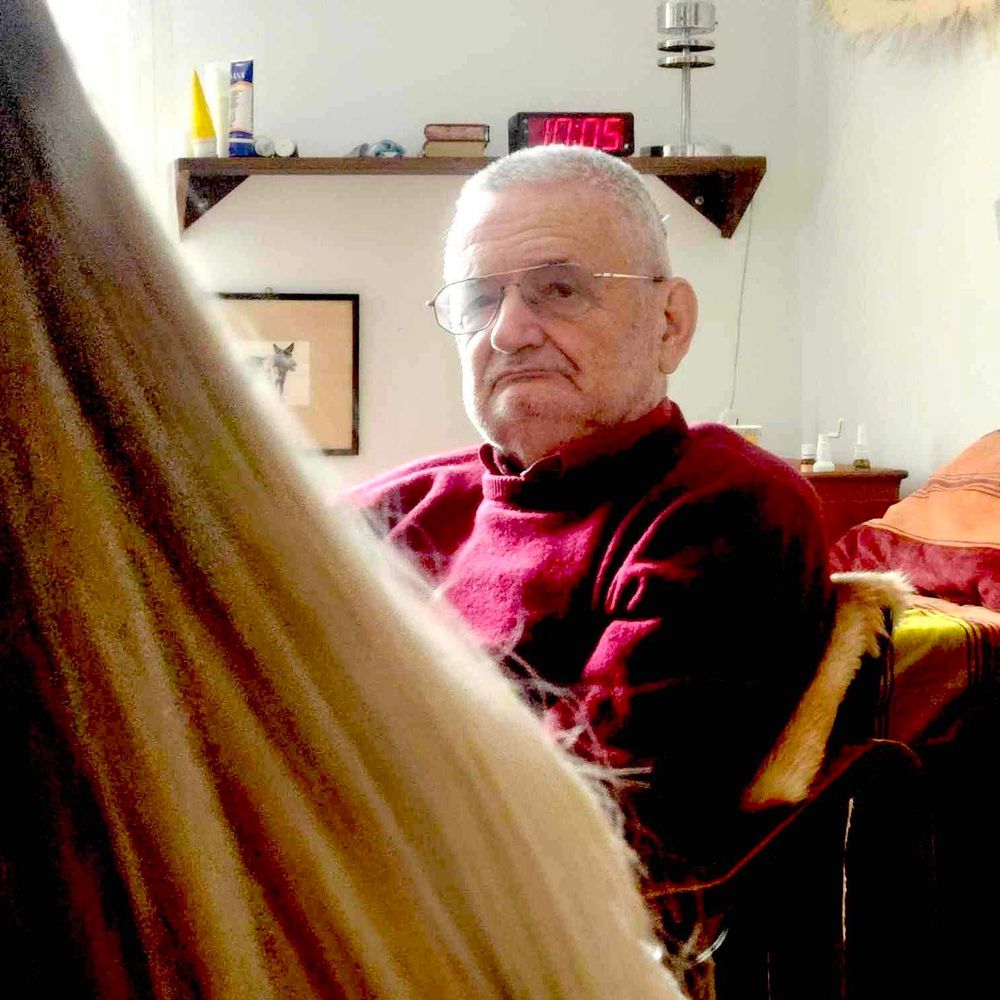
Most of his writings have become part of pop culture, and Janka the dog has become a personal acquaintance for all of us over the years. Vilmos Csányi, biologist, ethologist, biochemist, focuses primarily on animal and human behavior, as well as the questions of biological and cultural evolution. His book, titled Creative Imagination, serves as a kind of summary, examining how human imagination and creativity have developed and their role in the formation of cultures.
***
– Imagination and creativity are concepts fundamentally associated with humans, but how does this apply to animals?
Animals have a very limited imagination, as they cannot articulate it, yet it is crucial for survival, helping them escape from dangers.
Consider a mouse sitting in a hole, hearing a noise, and needing to decide whether it is just the wind rustling or if a cat is waiting outside. Imagining one scenario or the other is very important for it. But social animals also have individual imaginations to cooperate with others.
For example, highly social wild dogs catch prey under the guidance of their leader, following a plan, but they also need to imagine what the alpha male wants. It is also very interesting how wild dogs share food with each other. Whatever they catch, they all eat, and then when they return to the pack, mutual feeding begins. The hunters regurgitate the food and give it to the others. At this point, they pair up, and whoever has more in their stomach feeds the one who has less. If one has already received food but encounters another with even less in their stomach, they will feed that one. In about half an hour, the stomach contents of the group members equalize. The key is that if they have hunted little, everyone is equally hungry; if they have hunted a lot, then everyone is well-fed.
Similar observations have been made with ants when one individual was fed sugar marked with C14 isotopes to track the food’s journey. After some time, any ant taken from the colony visibly contained the passed-on food.
– You spoke about social animals, but let’s make a leap to humans: you also address how many problems can be traced back to individualism and the dissolution of livable, smaller communities. Of course, new ones are forming, such as the 10 Million Trees…
As a biologist, I like to work with precise definitions: in ethological terms, we cannot call this a community, because a community is where people are together all day, living and dying with their families.
A biological community is approximately two million years old, during which time the brain of Homo erectus doubled in size, precisely to enable the formation of communities. In other words, it was during this period that the genetic changes occurred that made humans capable of community formation. This was, by the way, a completely closed group consisting of 100-150 members.
In modern times, these communities are very rare, but the trait for community formation has remained within us. With the emergence of language, it became possible to name the community, which we accepted because the idea of belonging somewhere is a fundamental characteristic of ours.
Another fundamental aspect is the presence of a leader who sets meaningful goals and can articulate them sensibly. We need to understand what the goal is and what my individual task is.
We differ from animals in that my individual task, while different from the whole, can be aligned with it. This level of cooperation has been achieved in the animal kingdom by wild dogs, which have a hunting success rate of 80-90%, while all other predators have a success rate of 30-40%. They are less successful because, although they catch prey together, during the distribution, the hierarchy comes into play due to the less cohesive group.
– The emergence of language marked a turning point in the evolution of imagination and creativity. What changes did it bring?
When spoken language emerged, two things happened: first, beliefs began to appear. I see and experience something, I share it, the members of the community contribute to it, and in the end, a belief is formed, for example, that a certain plant causes diarrhea.
Secondly, there must be a willingness to submit so that people accept what the leader says. The central narrative does not need to be meaningful at all; that is irrelevant. The key is that they can believe it. It must be acknowledged that there are millions of people who do not need an explanation because they are not interested. An agreement must be reached in which this narrative can persist, and they are not called fools for acting accordingly. It is similar to religion.
It is a fundamental characteristic of humans to seek the possibility of belief, and one must operate in a way that allows this to function. Naturally, in a population of eight billion, there are countless such operations. It is truly fortunate that the fundamental, good trait of humans is that they are peaceful. Any other predator would not have survived in such numbers; they would have wiped each other out long ago.
It is known that hunter-gatherer societies were peaceful, living in networks that spanned thousands of kilometers, and they did not kill each other. People began killing each other five thousand years ago when small groups with highly imaginative leaders invented all sorts of nonsense. It can still be seen today how this works: if someone is in a position where they are believed, then they are also believed when they say it is not worth hunting or gathering when the neighbors are around. It is enough to raid them.
– Much has been said about the concept of community; I would like to return once more to a community like 10 Million Trees. Even if it does not fit the ethological or biological definition, in the everyday sense, it is still a community motivated by a common goal, and it even has a leader.
Of course, and it has a meaningful, good narrative. The question is how many people believe it, and what is the activity that must be undertaken based on this belief.
It is a very important movement, but it also needs to be effective. The goal is to shift thinking and attention in people’s minds towards environmentally conscious thinking.
– Is this thought, which could lead to a shift, the basis for a new culture or civilization?
Culture is the sum of all thoughts and behaviors of all people in a given place. What they do in the meantime—whether they run around naked singing by the fire or build concrete houses sky-high—is a detail, this behavior. One is like this, the other is like that; it is not worth morally condemning one or the other because they are equivalent.
Morality is not a separate thing; it arises from the existence of a community that has rules.
Of course, situations may arise that these rules do not cover, yet people still know what the rule would be if there were one.
And at such times, they behave morally. Morality is the ability to replace an unformed rule with something that fits into the system of rules. If the rules are constantly changing, then there is no morality.
– Recently, there was a press conference announcing the National Tree Planting Day by 10 Million Trees. We invited you, and it was a great pleasure that you came and support the initiative. What does the tree, the forest mean to you? I would think that as an ethologist, animals take precedence for you…
Humans are extremely social beings, striving to establish social relationships with the animals that come close to them. A normal person is not a true predator, although they lived on meat for two million years, which they of course supplemented with foraged and cultivated plants. In that sense, they did not become a predator in that they would enjoy killing. Most hunters also shoot from a distance; this is symbolic and does not affect their emotional personality as much as if they were doing it by hand, up close. This perspective sometimes extends to plants as well, as the relationship with them brings sociality to a higher level.
Recently, books have been appearing about thinking, running plants that can engage in conversation and communicate with each other. A certain percentage of this is probably true, as there may be some metabolism among them, but it is still a different world.
However, we do know what ecological relationship we have with them: they produce oxygen, we consume their fruits, life cannot exist without them, they provide shade, and they enable a bearable temperature on the planet. Those who accept this narrative contribute to the planet’s well-being.
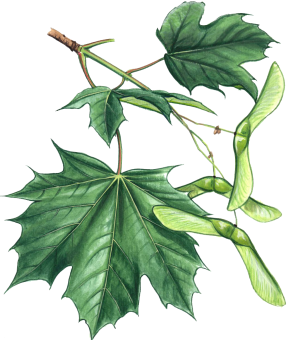
Trees are very sensitive beings; they rely on help. While, for example, a shellfish has its protective system on the outside, that is, the limestone shell, and the living organism is inside, in the case of a tree, it is the opposite. The outer layer of the tree is the living part, protected by a thin bark, while the inside is the lifeless part. In a sense, it serves protection because it provides support, allowing the tree to grow large. The many leaves that are necessary for survival to collect carbon dioxide must be accommodated. If it were only the thin, living part, animals would trample it, eat it, and it would be unsuitable for life. The inner, inert layer is necessary for it to anchor itself and grow larger.
Overall, the picture is not very pretty, at least regarding the current situation of plants, animals, and ecosystems. It is a fact that the total mass of humans and their domestic animals is currently four times greater than that of wild animals.
Only twenty percent of the biosphere remains. True, it would likely be very difficult to completely eradicate it to the point of hopelessness.
– Is there a point at which the biosphere collapses?
It has already collapsed; 80% has been destroyed. What remains is the agricultural sphere. The tree plantations or agricultural land planted in place of the deforested areas are also ecosystems, but we do not know how stable they are.
– The book discusses previous dramatic climate changes. Should we be more afraid now, or should we adapt?
It is not a good life when we are constantly terrified of what will happen in a hundred years, but we still need to be somewhat concerned, because if we do nothing, it will be those who come after us who will have to be afraid.
The question is how many percent of the population can understand the higher ecological connections and the desirable level of fear.
We need to understand how all this works and what actions might help. We should persuade people not to consume so much. If you say this in today’s world, almost everyone gets outraged because they want more, bigger, better, newer. We need to find a narrative that is acceptable, but it must include the idea that desires need to be trimmed down.
Environmental protection also needs to be explained to people, and it needs to be explained well, because most people only understand when something dramatic happens, like a major catastrophe. When a serious disaster occurs and lives are at stake, people are willing to do anything, to come together, to act.
Perhaps changing the mindset is not an impossible task, but it will still take two or three generations.
The source of the interview: Vulkán Magazine | https://vulkanfolyoirat.hu/nichs-andrea-csanyi-vilmos-teremto-kepzelet/