Either we will have a green society, or we will have nothing.
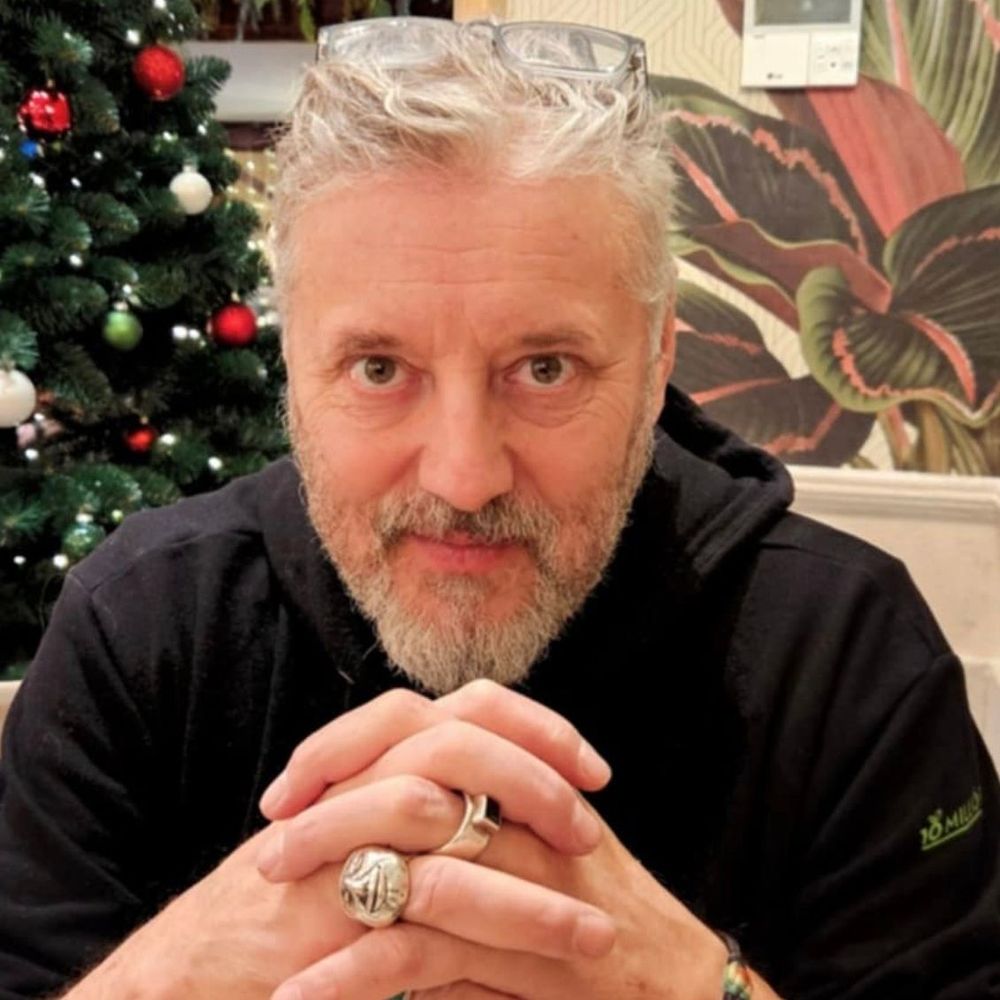
Art historian, founding editor, writer, teacher—one could list all the areas he has engaged in, even alongside his role as editor-in-chief of Vulkán, to this day. He considers himself a member of the human intellectual elite. A few years ago, as a responsible citizen concerned about the environment, he founded the community of 10 Million Trees. Our Christmas conversation.
***
– Many refer to your first Facebook post as the starting point that launched the 10 Million Trees community. Could you tell us exactly how that happened? Where were you, what were you doing, and why did it come to your mind at that particular moment? Just for the sake of historical accuracy…
It was July 6, 2019, an incredibly hot day, with a sweltering heatwave in Europe for weeks. I was spending a few days in Barcelona with my daughter, at the apartment of a dear acquaintance, right in the middle of the La Boca district. While she was still asleep, one morning I posted something that generated thousands of likes and shares within a few hours.
It reached over one and a half million people; as they say, Facebook exploded, so for the next three days, I was running back and forth on the rooftop terrace. It was there and then, with Sophie anxiously following the first days, that I laid the foundations of the 10 Million Trees community. Many people signed up, including some who have remained with us long-term, and many who have since dropped off, but fortunately, the number of new joiners is much higher.
This post also attracted Hervai Franciska, an old childhood friend of mine, whom I hadn’t seen in a long time. Since then, we have been working shoulder to shoulder; she became the main coordinator of 10 Million Trees, while I became the founder and president of the foundation. This is how the 1 person – 1 tree program started, which has brought together many enthusiastic team members.
What has happened in the past five years, and what were the main turning points?
The initial explosive impact was naturally followed by a period of consolidation, but now we are again on the brink of an explosion, as we recently announced the National Tree Planting Day, which we will celebrate on the first Saturday of March every year starting in 2025, with the goal of planting 10 million trees based on the principle of 1 person – 1 tree.
I am pleased because we have already managed to engage many respected and well-known individuals in this cause. This is again a moment when new people, new communities, and new businesses, as well as municipalities, can join us, which adds new dynamics to our activities. By the way, over the past five years, the 10 Million Trees community has been launched in about 160 municipalities, some of which are continuously active, while others join in occasionally; in any case, together we have planted more than 400,000 trees so far.
– You write on Facebook almost daily, and alongside environmental protection, you have long spoken out on public issues as well. If necessary, you go to Ukraine with the donations you have collected, or if life calls for it, you support Iványi Gábor or help those in difficult circumstances, or you campaign for the Jelenkor literary magazine. Your focus seems to be quite broad…
Every issue I engage with originates from the same place: I am a humanist intellectual, with a centuries-old European cultural tradition and serious family predecessors who have always stood up for public matters. Unfortunately, in recent years, they have managed to make people increasingly reluctant to take a stand on public issues at home; many feel that speaking out, expressing an opinion, or standing up for something based on values is embarrassing.
However, this seems strange and inexplicable to me. In the environment where I grew up, it was taken for granted that everyone was vigilant, active, and engaged in public life. Now, the climate catastrophe is the most pressing issue affecting everyone, and although I am neither an ecologist nor a biologist, as a humanist intellectual, I feel it is my duty to respond to it.
– From the way you speak, it is clear that you expect the intellectual community to engage in public affairs and environmental protection. What do you think about our situation at home in this regard?
Hungarian intellectual life today is like a magnetized compass, desperately searching for focus in all directions. Many prominent figures have left us in the past decade. There is a void in the intellectual space. Recently, many have reflected on this, including writer Endre Kukorelly, who nostalgically recalled our youth, a time that functioned better in this regard.
I feel that a large part of the Hungarian intellectual community has fallen asleep, is lost in its own world, dealing with trivial matters and hardly reflecting on any global issues. It’s as if they cannot conceive of the visible reality of humanity’s extinction. I do not perceive any response in literature or music. At most, theater and occasionally film react to the present. Everyone is wrapped up in their own very important private mythology. They themselves are even more important.
The last poem that spoke very harshly and substantively about the expected developments, major conflicts, and dramatic turns of the 21st century was written by György Faludy in 1980.
No one here is inspired by the data, facts, and trends that science has presented to us in recent years, from which much can be inferred about the not-so-distant future.
For example, the French have their excellent writer, Michel Houellebecq, who regularly tramples on the nerve endings of society, which is a traditional mode of behavior for them. He has the courage to address topics that society, and especially politics, would like to taboo.
In Europe, I see Lars von Trier, the Danish filmmaker, as another such figure. Both are necessarily abrasive and provocative, but even the most radical public attitude pales in comparison to the radicality represented by the climate catastrophe. For instance, the Hungarian intellectual community should reflect on these individuals daily.
Or if they are distant, then at least on the few who are available to us.
Take Gábor Karácsony or András Lányi, for example. Culture always derives its depth, strength, and significance from the layering of dialogues. So does Hungarian culture. One thought must build on another, and one generation must build on the achievements of the preceding generation.
When Lányi tied himself to a tree in front of the Gresham, I was living in another universe, and I received the action with considerable skepticism. It took years for me to realize how important the gesture he made was, and a little more time for us to build the symbolic act surrounding the 10 million Trees onto this action.
In 2022, when we gathered for the one and only time during our operations to protest against the deforestation decree, I announced the event at the same place, in front of the Gresham, because in a certain sense, it had been sanctified by Lányi’s gesture. Also, because there stands, almost lies, the very old acacia that has witnessed the birth and growth of Budapest around it. We need to think in these time scales when contemplating our future.
I consider this to be the essence of culture: the discourse, the dialogue between individuals and generations, and of course, between movements. I am tired of the lamenting, analyzing intelligentsia. And I am tired of conferences, panels, the whole talk industry. We should have acted long ago.
Those who are responsible for societal matters by profession cannot retreat to club rooms to chat when the time comes, and here comes the price. At such times, everyone has work to do on the dam. The environmental disaster is not going to happen; it is already here.
– What does a tree mean to you?
For me, a tree is a universal metaphor that condenses many emotions and messages. Every person has a tree within them, every person’s feet touch the ground, and everyone’s head, their consciousness, is open to the real and the ideal sky.
A tree also clings to the ground, drawing its life-giving sap from there, but through its branches and leaves, it seeks a connection with the sun, with the sky. In this vertical operation, in the upward flow striving from below, it performs that incredibly wonderful task that allows us humans to live here on Earth.
We need trees for life, and now we have reached a moment in civilization when trees also need us. For humanity to accomplish this work, we must be able to become a forest in a coordinated manner, paying attention to one another. A society like that of a forest, where many types of trees and plants coexist alongside each other.
Trees and plants of different sizes and ages living on multiple levels. If we observe the functioning of a forest, we receive much advice on how we, as a society, should operate healthily.
In comparison to the climate disaster, we are occupied daily with laughable banalities. It is far more important for humanity to watch the idleness of people without knowledge, preparedness, and performance for several hours a day on television or TikTok than to focus on the essence of how we will live. Or rather, how we will not live. As it stands, there is a chance for this. Nothing is more important right now.
Creation exists, nature has come into being according to its own logic. This can be grasped by fantastic scientists and extremely sensitive artists, but we humans have little else to do right now than to understand this functioning, even the functioning occurring within our own bodies. Because, quite literally, everything is one! We humans must free ourselves from the notion that the Earth, nature serves us.
The Meadows Report, financed by the Club of Rome, titled The Limits to Growth, was published in 1972. An extremely important study volume.
Since then, we know for sure what we are doing and where we are heading, namely that we are cutting the branch we are sitting on day by day. In 1978, in Milan, an artist who later became famous for his houses in Vienna, Hundertwasser, demonstratively planted a forest in an apartment. His message was that people and nature need to reconnect. He said this at a time when the liberal market economy and the model of representative democracy were at their peak, and social groups that had previously been marginalized were rapidly becoming wealthy.
In the 1980s, another German artist, Joseph Beuys, planted 7,000 trees in Stuttgart, with the same message. I do not believe that planting 10 million trees should be an artistic gesture, but I also do not want to let go of the symbolic content that lies beyond the actual planting in this gesture, which Hundertwasser and Beuys worked with.
Anyone who has planted a tree in their life experiences that it is a small moment in creation. A small thing, but it is precisely in its smallness that its uplifting and inspiring greatness lies. This kind of humanistic attitude and motivation to protect civilization drives me. That is why we want to involve and engage every citizen through National Tree Planting Day.
– Could the realization of the idea of “let’s become a forest” be National Tree Planting Day, as you mentioned? It also has a deeper message.
Yes, because unfortunately, this is a consciously and very long-divided society. We can be very aggressive, we express extreme opinions about each other, but one thing far exceeds all of this. There is no one who can say what political system will operate in Hungary a hundred years from now and who will be its leaders.
One thing we can be sure of: the temperature will be several degrees warmer, it will be Budapest-like in Stockholm, and Naples-like in Budapest.
The city of Budapest was not built in a Neapolitan way; it is not divided by narrow alleys, but by wide streets, where sunlight falls in a completely different way, heating the asphalt and the walls differently. Therefore, a rough urban architectural adaptation will also be necessary. If the Gulf Stream stops, then even this prediction will not hold true, and it will occasionally be as cold in Marseille as it is now in Oslo.
– What is your vision regarding the biodiversity and climate crisis?
I believe in action, which is why I am confident that next year, on March 1, Hungary will plant trees.
Although Hungarian society is divided, overall it is still a forest where people pay attention to what matters.
Everyone wants to live in a healthy environment and pass that on to their children. That is why the experience of planting even a single tree is important, because then you have already planted the first tree of the forest, participated in a communal act, and that is uplifting.
In two or three years, I would love to say that we planted millions of trees in a single day. Let this be Hungary’s ambition. Let us show other nations that despite all the current political disputes that become outdated in a few years, we are capable of coordinating our actions for the sake of our children’s future.
We are capable of acting for the distant future instead of the near future. This can be a kind of response that we can provide together: schools, choirs, football teams, yoga practitioners, any group or community that comes together for entirely different reasons, but in this one thing, once a year, everyone joins in for the sake of common sense. It is not hard to see that there is a huge need for this.
– I really like how you speak about this as something that will definitely come to fruition. But how can this kind of optimistic, active ethos be embraced by so many people who have become jaded by everyday problems? Why do you think the country will respond to this call?
This is the most important question in this whole equation. Humans are anthropologically programmed for the short term; we do not think much about generations ahead. Can we move beyond this or not? If not, we will fail.
I believe that humans are adaptive beings and have the capacity to transcend their encoded limitations and flexibly adjust to the increasingly pressing environmental situation, providing the right individual and collective responses.
A fascinating example is China, where powerful environmental measures are being implemented, the transition to solar energy is progressing rapidly, and millions have been involved in environmental work and reforestation. They are huge carbon emitters, yet they see that they need to reduce this, and they are already taking the steps needed for the transition that are aimed decades ahead. Of course, this is an Asian, collectivist society where the individual is subordinated to the collective. This is reflected in their legal system, their ethics, and their social control system.
All of this is not familiar or comfortable for us here in Europe; the European social structure reinforces and honors individual values.
It is a civilizational question how we can reconcile this, whether we can be rational individuals who coordinate their work based solely on common sense. The fact that China has managed to combine dictatorship and market economy is a kind of innovation and response. It is a step beyond the peak of the 20th century, which Fukuyama defined as the end of history. But there is no guarantee that China will win this competition. After all, there are many problems there as well, including a real estate crisis and the need for birth control measures.
The sudden advantage that the marriage of command economy and market initially brought is diminishing. In democracy, in liberal market economy, in representative systems, in civic consciousness, and in action based on common sense, I believe there are still plenty of prospects.
– So, does the environmental crisis bring about a completely new form of civilization?
What needs to be born is a green civilization.
A world in which ecological elements, motifs, and values will play a much more prominent role. And this is not just a mere shift in perspective, but a radically different way of life than what we practice today. I cannot say what it will specifically look like, but there is a huge need for natural scientists, sociologists, creatives, artists, and all forward-looking individuals in its conception.
It is evident that we have exhausted natural resources; soon there will be no more oil, lithium, or freshwater. In this way, the notion that some individuals can have more of these common natural resources that serve the benefit of humanity will no longer be sustainable.
Two paths follow from this.
Either the conflict will intensify, leading to the emergence of a very narrow, militarily powerful authoritarian global elite that subjugates the entire 8 billion population of the Earth to its will, or humanity will transcend capitalism, which carries the legacy of feudalism, and step into a new level. Survival, in fact, cannot be imagined without a proportional and fair social perspective.
Either there will be a green civilization, and we will establish a green society, or there will be none at all.
Photo: Bojár Sophie
Bahget Iskander took the photograph of György Faludy
Source of the interview: Vulkán magazine
Previous interview: Zoltán Kun – We Treat Forests as Cutting Animals